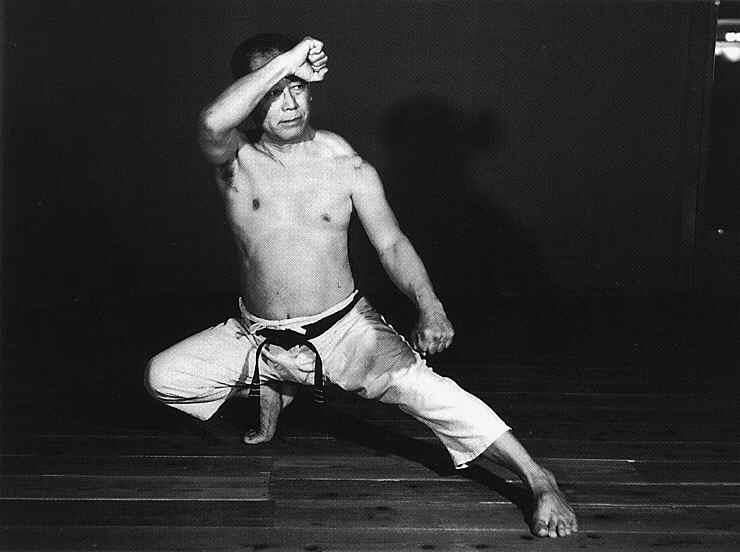
Grandmaster Nagamine Demonstrating Kata
Introduction:
Eighteen (18) kata are practiced in Shorin-Ryu, Matsubayashi-Ryu. (The late Hanshi Ueshiro of Shorin-Ryu Karate USA, also developed and taught Fukyugata III.) In the early years students would practice a single kata for 3 years or more before being allowed to learn a new kata. Shorin-Ryu's most advanced kata, Kusanku, was said by Master Nagamine to take at least ten years to master. At three years a piece and 10 for Kusanku it would take a dedicated student 61 years to "perfect" all eighteen kata! Katas are never changed. There are also unlimited bunkai (fighting) applications to each individual kata. Here is a short description of the various kata Matsubayashi-Ryu kata..
NOTE: Clicking on the name of the kata activates a video link of that kata. These clips were created and the kata performed by Sensei Jim Sindt. These files were filmed during a training course in the BSI Dojo Bergen/Norway and originally posted on http://www.matsubayashi-ryu.net. These clips have since been converted from their native PAL/MPEG format to NTSC/WMV format. All of these clips can be found on YouTube as well but, in point of fact, all video rights remain with Sensei Jim Sindt.
The various sub-divisions of Matsubayashi-Ryu practice each kata with slight variations from sub-division to sub-division. You CANNOT learn kata from a video clip but if you know or are learning the kata these clips can help you remember the sequence and flow of the kata. Consult your individual Sensei for specifics of how the kata is executed in your dojo. - Webmaster.
The Fukyugatas (Promotional Katas)
Fukyugata Ichi, and
Fukyugata Ichi, Half-Speed
The Fukyugatas ("Promotional Katas"): Fukyugata I was created by Master Shoshin Nagamine in 1940 and Fukyugata II by the Master of Goju-Ryu, Chojun Miyagi. These two introductory kata were originally requested to be created by a special committee of all the Okinawan Karate-Do Association organized and summoned by the governor of Okinawa at that time, Mr. Gen Hayakawa. The reason for the inception of these two introductory kata was to allow beginners and school children to approach Karate practice in the most lenient way possible.
The Pinan (Peace) Katas:
Pinan Shodan, and
Pinan Shodan, Half-Speed
The Pinan's (The Peace Katas) Shodan through Godan were created by Yasatsune "Anko" Itosu in 1907 and were intended to be practiced by high school students as an integral part of the regular curriculum. When Ginchin Funakoshi introduced karate to mainland Japan he modified the Pinan katas and renamed them "Heian" in Japanese. Additionally the Shotokan system he founded changed Pinan I to Heian II and Pinan II to Heian I.
There is some discussion whether Itosu Sensei developed the Pinans from the more sophisticated "Black Belt" katas or if they were developed from a mysterious kata known as "Chanan". We may never know the full truth
The Naihanchi (Horse Riding) Katas:
Naihanchi Shodan, and
Naihanchi Shodan, Half-Speed
The Naihanchi (Horse Riding) katas are adaptations of the Chinese Shaolin form Naifuanchin. They were modified by Ankho Itosu, who was also the originator of the Pinan (Heinan katas). The Naihanchi katas were traditionally the first katas a student would learn. They are charachterized by powerful lower body movements and all movements are conducted left and right in a straight line from the starting position. In the Shotokan system these katas are known as the Tekki katas. When the Pinan katas were introduced in 1907 they replaced the Naihanchi katas as introductory katas. When the Fukyugata's were introduced they replaced the Pinans. Students now learn the Fukyugatas, then the Pinans, then the Niahanchis before moving on the to "black belt" or fighting katas.
Yudansha Katas:
Anaku (Ten Gods) and Anaku, Half-Speed
The first of the so called "Black-Belt katas". Originally a Chinese form, it was brought from the island of Formosa (later the country of Taiwan). It is characterized by strong power movements. Most movements are performed in the zenkutsu-dachi stance.
Wankan ("Kings Crown") and Wankan, Half-Speed
The composer of this kata is unknown as well, but it has been practiced for a long time primarily in the village of Tomari on Okinawa. This kata combines elegant but powerful movements in both attack and defense sequences.
Another kata created by an unknown master. It too was practiced predominatly in Tomari village. The characteristic of this kata is the one-foot stances where the other foot is drawn to deliver a quick snap-kick. It is not as long as some of the other katas (27 movements) but has a powerful, graceful flow to it.
It is believed that this kata was brought to Okinawa in 1683 by a Chinese envoy named Wanshu; but later, this kata was reformed and developed by Karate men of Tomari Village. The characteristic of this kata is the execution of hidden fist punches (kakushi-zuki).
The composer of this kata is also unknown. The characteristic of this kata is the execution of knife-hand techniques. This kata was the favorite of Sensei Kyan.
Gojushiho (literally "54 Steps") and Gojushiho, Half-Speed
The composer of this kata is also unknown. Goju-Shi-Ho literally means 54 steps. The characteristics of this kata are the spear-hand thrust and the resemblance of a drunken man's movements.
The composer of this kata is unknown. The characteristics of this kata are the execution of a flying kick, and every movement is composed in a diagonally straight line.
Kusanku and Kusanku, Half-Speed
This kata was adopted and developed by Okinawan Karate men after it was brought to Okinawa in 1761 by a Chinese Martial Artist named Kusanku. This kata is the most magnificent and advanced kata of all Matsubayashi Ryu Karate. It is also the longest and most difficult kata, requiring painstaking practice for more than a decade for mastery.
In addition to the 18 katas, Yakusoku Kumite (Promise Kumite) forms are practiced. These forms were heavily influenced by Choki Motobu.
Order Grand Master Nagamine's (click on cover)
Fukyugata Ni, and
Fukyugata Ni, Half-Speed
Pinan Nidan, and
Pinan Nidan, Half-Speed
Pinan Sandan, and
Pinan Sandan, Half-Speed
Pinan Yondan, and
Pinan Yondan, Half-Speed
Pinan Godan, and
Pinan Godan, Half-Speed
Naihanchi Nidan, and
Naihanchi Nidan, Half-Speed
Naihanchi Sandan, and
Naihanchi Sandan, Half-Speed
Matsubayashi-Ryu Katas on Video:
THE ESSENCE OF OKINAWAN KARATE-DO
The Manual to Shorin-Ryu Matsubayashi-Ryu Karate